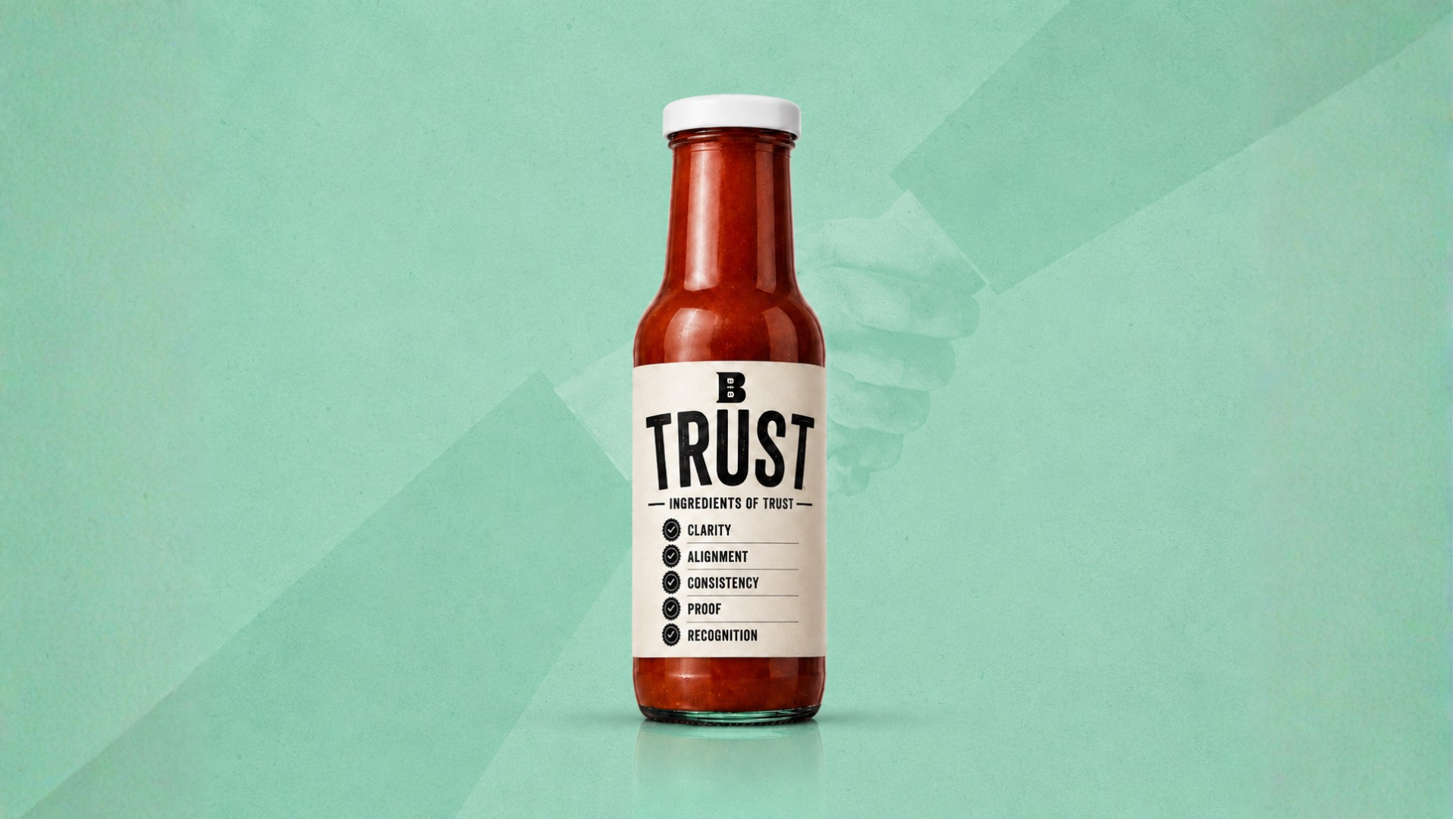
Are you making your brand easy to trust? 

Trust is one of those words brands love to use. 

“Trusted since 1987.” 

“The trusted choice.” 

“A name you can trust.” 

The problem is, saying it does not make it true. 

Trust is not something a business can simply claim – it’s something people build up over time, based on what they have seen, heard and experienced. 

And it has never been easier for brands to lose people. There are more channels, more content, more messages and more information fighting for attention, but less patience and less time to care. Confusion is costly. 

If your brand is unclear, inconsistent or unfocused, people will not spend long trying to work you out. They will move on to something easier to understand – and easier to trust. 

Why trust matters 

Trust makes choosing easier for consumers. That, in turn, makes it commercially valuable for businesses. 

People do not have the time or inclination to evaluate every available option in forensic detail, so they rely on trust-based shortcuts. They choose brands they recognise, understand, have heard good things about or have already had a positive experience with. 

A trusted brand is easier to choose, easier to recommend and easier to return to. People are also more likely to stick with it and forgive it when something goes wrong.  

Where trust starts to break 

Many brands are harder to trust than they realise. They are too vague about what they do, too internally focused in how they talk about it, too inconsistent from one channel to another or too similar to everyone else in the category. Some keep changing direction before people have had a chance to understand them in the first place. 

And trust does not usually disappear in one dramatic moment. It is built or eroded in the small stuff. Through the clear, consistent experiences people have across every touchpoint, from the website and sales call to the invoice, delivery and response when something goes wrong. 

A brand can say it is helpful while its website makes life harder. It can call itself human while its service feels robotic. It can talk endlessly about innovation while the experience feels ten years out of date. 

When the gap between what a brand says and what people experience becomes too wide, trust starts to break. 

Put your brand to the test 

So, how do you know whether your brand is genuinely easy to trust? 

At BIG, we use a simple trust test when we start working with a brand. It looks beyond what an organisation claims and asks whether the business is making its promise clear, believable and consistent across the whole experience. 

It comes down to five questions: 

1. Clarity: Do people know what you stand for? 

Ask three people in your business what the organisation stands for and you will often get three different answers. That is a problem, because people cannot trust something they do not properly understand. 

Your audience should be able to grasp what you do, why you matter and what makes you worth choosing without decoding a wall of corporate language.  

Clarity is not about dumbing things down, it’s about making the important parts easy to understand. If a potential customer could not explain your business after visiting your website once, the brand is making them work too hard. 

2. Alignment: Would your people say the same thing? 

Trust slips when the leadership team tells one story, the sales team tells another and the customer experience delivers something else entirely. Alignment starts inside the organisation. 

Your people need a shared understanding of what the business stands for, how it creates value and what kind of experience it wants to provide.  

That does not mean giving everyone a script, but having a clear North Star gives the business one organising idea, so different teams can express the same brand naturally through what they say, do and prioritise. 

3. Consistency: Are you recognisable across every touchpoint? 

Great brands are surprisingly repetitive. It might not sound glamorous, but repetition is how they become familiar, understood and trusted. 

Consistency does not mean repeating the same thing everywhere or making everything look identical. It means every interaction feels as though it came from the same place.  

Your website, advertising, emails, sales materials and customer service can all do different jobs, but they should still feel connected. When every channel behaves like a different business, people must keep reassessing who you are. 

4. Proof: Are you demonstrating it through experience? 

Brands spend a lot of time deciding which words they want to use about themselves. Helpful. Expert. Friendly. Innovative. Reliable. But people are far more interested in whether the experience proves them true. 

If you say you are easy to deal with, how simple is it to contact you? If you say you care about customers, what happens when one has a problem? If you say quality matters, where can people see and feel it? Trust grows when the promise and the experience reinforce one another.  

Brand can make the truth easier to see. It cannot manufacture it. 

5. Recognition: Are you distinctive enough to be remembered? 

Being clear and consistent is important, but it will only get you so far if the brand is impossible to pick out from the category. 

If you look, sound and behave like every competitor, people will struggle to remember who said what. Distinctiveness gives them something to hold on to, whether that comes from your visual identity, tone of voice, attitude, point of view or customer experience.  

The aim is not to be different for the sake of it. It is to be easier to recognise, easier to recall and easier to choose. 

Trust is a pattern, not a message 

That is what the trust test is really measuring. Not what you claim in one campaign, but the pattern created by every interaction. 

Clear. Aligned. Consistent. Proven. Recognisable. 

So, the question is not whether you tell people your brand can be trusted. It’s whether you are making it easy for them to believe you. 

To put your brand to the test, get in touch: [email protected] 

From strategy to billboard: How brand becomes something people actually see

Great marketing usually comes down to one simple thing: get your brand right, then tell people about it.

Obviously, there’s a lot that sits underneath that. Research, positioning, audience insight, messaging, creative development, media planning, measurement, all the useful grown-up stuff. But as a basic principle, it stands up.

Before you start thinking about media plans, TV ads, billboards, social campaigns or anything else, you need to be clear on who you are, what you stand for, why people should care and what you actually want them to remember.

Because before a brand becomes a billboard, it has to become a clear idea. And by “brand”, I don’t just mean a logo, a colour palette or a nice line on a presentation slide. Those things matter, but they are not the whole brand. They are the visible parts of it.

A brand is the thing people come to understand, feel and remember about you. It is your reputation, your role in people’s lives, your point of difference and the promise you keep making, whether you mean to or not.

Building a brand starts with a few simple but important questions: Who are we? Who are we for? What do we stand for? Why should people choose us? What should we be known for? And how do we want people to recognise us every time they come across us?

Once that is clear, everything else has something to work from. The identity makes the brand recognisable. The tone gives it personality. The message gives it clarity. The campaign gives it reach.

That is the job of brand building: to create a clear thread from what you stand for to how people experience you.

The trouble is a lot of brands lose that thread. They either get stuck in strategy, endlessly refining the thinking until it becomes a polished deck that never properly leaves the boardroom, or they jump straight to execution before the bigger brand idea has really been nailed.

That’s when the work starts to feel disconnected, because the most important bit is often the journey in the middle: turning the brand strategy into identity, messaging and communications that people can actually see, hear and remember.

Before you buy the media space, build the thing you want people to remember

A good brand strategy should create a clear path for everything that follows. It should define the core idea, shape the identity, sharpen the message and guide how the brand behaves across creative, media, channels and the customer journey.

The order matters, because if you start with the channel, the work often becomes about filling space: We need an outdoor campaign. We need a TV ad. We need something for social. We need a banner ad.

But without a joined-up idea behind it, that activity can quickly become random. Different messages, different executions and different bits of budget all pulling in different directions.

That doesn’t just make the campaign weaker. It makes it harder for people to understand what you actually want them to remember.

That’s where one clear idea becomes so important.

And that’s the difference between a genuinely integrated campaign and a media plan with matching assets. I noticed a really good example of this recently with the 7UP Pink Lemonade activity I spotted in Manchester, which felt like a really smart bit of joined-up brand activity.

On the bus into work, the free paper had a front-page wrap. Then across town, the digital and static out-of-home screens were full of that distinctive pink, with simple messaging around refreshment and mood-boosting. As I walked through the city, there were samples being handed out, bits of experiential activity and merch giveaways. Then when I opened my phone, I was served digital banner ads.

None of it felt complicated. But it all made sense and felt connected. That was the point.

It was pink. It was refreshing. It was everywhere. And it all felt like part of the same moment.

That’s what happens when clear brand thinking meets good channel thinking. It doesn’t just repeat the same advert in different sizes. It builds a world around the idea, and a quick burst of activity can suddenly feel much bigger than the media spend because people experience it in different places, in different ways, across the same day.

A paper wrap gives it visibility. Out-of-home gives it scale. Sampling puts the product in your hand.

Experiential makes it feel active. Digital picks it back up when you’re on your phone.

Each channel has a job. But brand holds it together.

Make every channel do the right job

In my opinion, that’s why out-of-home, TV and even print still have such an important role, especially in a digital-first world. They are not competing with digital. They complement it.

In a world of endless scroll, anything physical or public can have disproportionate impact. A billboard interrupts differently to a banner ad. A TV spot lands differently to a paid social post. A print wrap feels more deliberate than another thing disappearing up a feed. Experiential can turn the idea into something people actually touch, taste or do.

That doesn’t make one channel better than the other. It just means they do different things. The mistake is expecting every channel to do the same job.

The better way to think is to ask: what role does this channel play in the journey?

Because people don’t experience brands in neat media plan columns. They don’t think, “That was my awareness touchpoint, now I’m entering consideration”. They just notice things. Remember things. Click things. Talk about things. Walk past things. Try things.

So, the job is to make those moments feel connected.

That’s where brand strategy earns its keep. Not by making everything more complicated, but by making it easier to understand what every piece of activity is there to do.

If your brand is clear, your message gets sharper. If your message is sharper, your creative gets stronger. If your creative is stronger, your media works harder. And if your media works harder, your campaign has a much better chance of being remembered.

Make it easy to recognise, wherever it appears

This is also why the basic building blocks matter. The proposition. The positioning. The message. The tone of voice. The logo. The line. The colours. The visual world.

Some of those are strategic. Some are verbal. Some are visual. But together, they create a system people can recognise. They help people join the dots quickly. They make the brand easier to spot, easier to understand and easier to recall.

In the 7UP example, the pink did a lot of the heavy lifting. You didn’t need to stand there decoding the campaign. You just got it. The colour, the message, the product and the media all worked together.

That’s the sweet spot: simple enough to recognise, strong enough to stretch and distinctive enough to remember.

Because the billboard is not the brand or the strategy, nor is the TV ad or the social post.  They are where it becomes visible.

So yes, get your brand right, then tell people about it. But don’t skip the bit in between: defining what the brand is, building the system around it, turning that strategy into a clear message, and then creating a connected set of moments that work together across channels.

That’s when “telling people about it” becomes more than buying media space. It becomes something people actually notice. Or better still, something they actually remember.